 | BLUETOOTH WIRELESS FOR ROBOTS |
 Classes of Bluetooth
Bluetooth comes in three classes. Transmitting range cannot be explicitly stated for each device class; every environment is slightly different, and affects the signal in different ways. The best way to compare a devices' operating range is bycomparing Output Power. A higher output power means a longer range.
Classes of Bluetooth
Bluetooth comes in three classes. Transmitting range cannot be explicitly stated for each device class; every environment is slightly different, and affects the signal in different ways. The best way to compare a devices' operating range is bycomparing Output Power. A higher output power means a longer range.
- Class 1 - Long Range
- Maximum Output Power of 100mW (20dBm)
up to 100 meter range
- Class 2 - Medium Range (the most common)
- Maximum Output Power of 2.5mW (4dBm)
up to 10 meter range
- Class 3 - Short Range (very rare)
- Maximum Output Power of 1mW (0dBm)
up to ~1 meter range
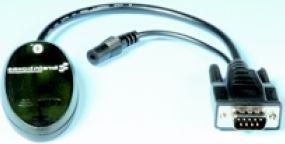
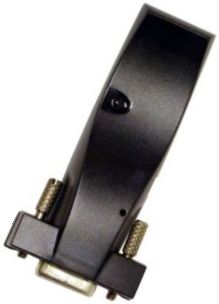
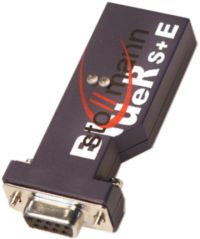 A Bluetooth rs232 Adaptor allows any device with an rs232 port to communicate with another Bluetooth device without the need for additional software/drivers.
But as mentioned before, you could still get a Bluetooth module and plug it directly into the micrcontrollers' UART pins. Stollmann also offers many Bluetooth modules.
What About The Computer End?
The part that connects to your computer will be a USB Bluetooth dongle. There are hundreds of these on the market and are very easy/cheap to find and buy.
A Bluetooth rs232 Adaptor allows any device with an rs232 port to communicate with another Bluetooth device without the need for additional software/drivers.
But as mentioned before, you could still get a Bluetooth module and plug it directly into the micrcontrollers' UART pins. Stollmann also offers many Bluetooth modules.
What About The Computer End?
The part that connects to your computer will be a USB Bluetooth dongle. There are hundreds of these on the market and are very easy/cheap to find and buy.
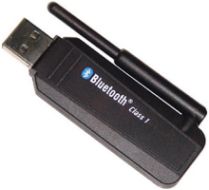
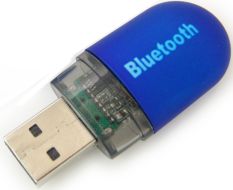 Notebooks can use Bluetooth via a PCMCIA card or a USB dongle. There are Bluetooth adapters for PDAs and PDAs with integrated Bluetooth functionality. There are also Bluetooth enabled phones (robot controlled by your mobile, anyone?).
Because the Bluetooth module basically acts like a wireless serial cable, the software on the connected devices does not typically need to be modified.
Notebooks can use Bluetooth via a PCMCIA card or a USB dongle. There are Bluetooth adapters for PDAs and PDAs with integrated Bluetooth functionality. There are also Bluetooth enabled phones (robot controlled by your mobile, anyone?).
Because the Bluetooth module basically acts like a wireless serial cable, the software on the connected devices does not typically need to be modified.
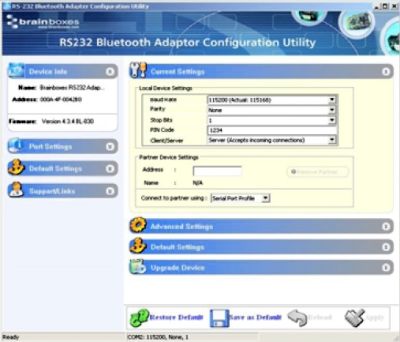
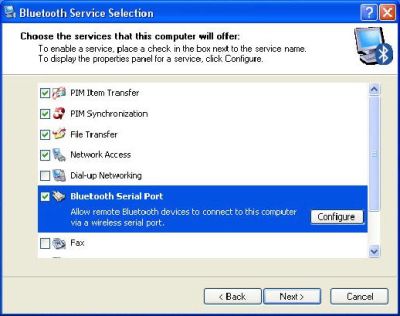 To operate the device, just install the included drivers and software that comes included.
 Costs, Where to Buy
While the USB Bluetooth adaptor is very common and cheap ($15-$40), the rs232 Bluetooth adaptor would be $80+. The 'Bluetooth Industry' is rapidly growing, so keep on the lookout for newer cheaper and better products often.
A good place to find Bluetooth modules would be at Sparkfun.com.
Brainboxes.com offers rs232 Bluetooth adaptors.
I have found many other sites offering Bluetooth chips/modules, but the ones above looked the easiest/cheapest to work with at the time of this writing. There are a few Bluetooth products in the ads, too.
Costs, Where to Buy
While the USB Bluetooth adaptor is very common and cheap ($15-$40), the rs232 Bluetooth adaptor would be $80+. The 'Bluetooth Industry' is rapidly growing, so keep on the lookout for newer cheaper and better products often.
A good place to find Bluetooth modules would be at Sparkfun.com.
Brainboxes.com offers rs232 Bluetooth adaptors.
I have found many other sites offering Bluetooth chips/modules, but the ones above looked the easiest/cheapest to work with at the time of this writing. There are a few Bluetooth products in the ads, too.
 Extra Information - WiFi vs Bluetooth
What are the differences between WiFi and Bluetooth?
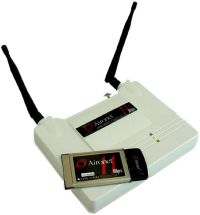
IEEE 802.11b offers faster speeds and greater range than Bluetooth. While Bluetooth has a weaker radio signal, this provides for more conservative use of battery power (designed for PDAs, wearable headsets, cell phones). Wifi's stronger signal provides more range, but uses 10 to 100 times more power than Bluetooth (designed for notebook computers, where the additional current drain is negligible).
The two systems share space. But WiFi uses te 2.4 GHz radio band/Direct Sequence Spread Spectrum (DSS), not frequency hopping (FHSS) such as with Bluetooth. Bluetooth also doesn't typically have an access point. Devices on a Bluetooth PAN communicate directly with one another. IEEE 802.11b allows mobility over a very large area. When out of range of one IEEE 802.11b access point, another takes over.
In the unlicensed 2.4 GHz radio spectrum, and it is possible for Bluetooth and IEEE 802.11b systems to interfere with one another. The 2.4 GHz Industrial, Scientific, and Medical (ISM) radio band is 83 MHz wide. The ISM band is also used by the HomeRF wireless networking system, cordless analog and digital phones, microwave ovens, and some medical equipment. As is the case with most unlicensed radio bands, no one "owns" any particular frequency in the band, so users must share the radio spectrum. Generally keeping the devices far from each other distance wise will dramatically reduce interference - but dont worry too much, the FCC requires all of these devices to 'play nice' and be resistant to interference.
Extra Information - Why is it Called 'Bluetooth'?
Apparently it was named after Harald Bluetooth, the King of Denmark in the late 900's. He united Denmark and part of Norway into a single kingdom, so supposedly thats the link. But then he got owned by his son. Look him up . . .
Extra Information - WiFi vs Bluetooth
What are the differences between WiFi and Bluetooth?
IEEE 802.11b offers faster speeds and greater range than Bluetooth. While Bluetooth has a weaker radio signal, this provides for more conservative use of battery power (designed for PDAs, wearable headsets, cell phones). Wifi's stronger signal provides more range, but uses 10 to 100 times more power than Bluetooth (designed for notebook computers, where the additional current drain is negligible).
The two systems share space. But WiFi uses te 2.4 GHz radio band/Direct Sequence Spread Spectrum (DSS), not frequency hopping (FHSS) such as with Bluetooth. Bluetooth also doesn't typically have an access point. Devices on a Bluetooth PAN communicate directly with one another. IEEE 802.11b allows mobility over a very large area. When out of range of one IEEE 802.11b access point, another takes over.
In the unlicensed 2.4 GHz radio spectrum, and it is possible for Bluetooth and IEEE 802.11b systems to interfere with one another. The 2.4 GHz Industrial, Scientific, and Medical (ISM) radio band is 83 MHz wide. The ISM band is also used by the HomeRF wireless networking system, cordless analog and digital phones, microwave ovens, and some medical equipment. As is the case with most unlicensed radio bands, no one "owns" any particular frequency in the band, so users must share the radio spectrum. Generally keeping the devices far from each other distance wise will dramatically reduce interference - but dont worry too much, the FCC requires all of these devices to 'play nice' and be resistant to interference.
Extra Information - Why is it Called 'Bluetooth'?
Apparently it was named after Harald Bluetooth, the King of Denmark in the late 900's. He united Denmark and part of Norway into a single kingdom, so supposedly thats the link. But then he got owned by his son. Look him up . . . Reference - society of robot.
